Bringing Industrial Knowledge into Immersive Reality
Imagine an aircraft technician practising maintenance procedures without taking an aircraft out of service. An engineer inspecting electrical infrastructure while receiving digital instructions directly in their field of view. Or a factory worker assembling equipment alongside a collaborative robot, guided step by step through an immersive experience.
These scenarios demonstrate the potential of Extended Reality (XR), which includes virtual, augmented and mixed reality. However, bringing XR into everyday industrial operations remains challenging.
The difficulty is not simply displaying three-dimensional objects through a headset. Industrial XR applications require reliable procedures, accurate equipment models, appropriate interactions and up-to-date technical knowledge. Creating these experiences often demands specialised expertise, considerable time and programming skills.
Addressing these challenges was the central theme of the MOTIVATE XR workshop, held on 4 November 2026 during the EuroXR 2026 International Conference in Valencia, Spain.
Entitled AI-assisted No-Code Authoring and Experiencing Tools for Industrial XR Training and Assistance, the workshop brought together European research and technology partners for six invited presentations exploring how artificial intelligence, accessible authoring tools, computer vision and immersive technologies can support industrial training and assistance.
MOTIVATE XR: Making Industrial XR More Accessible
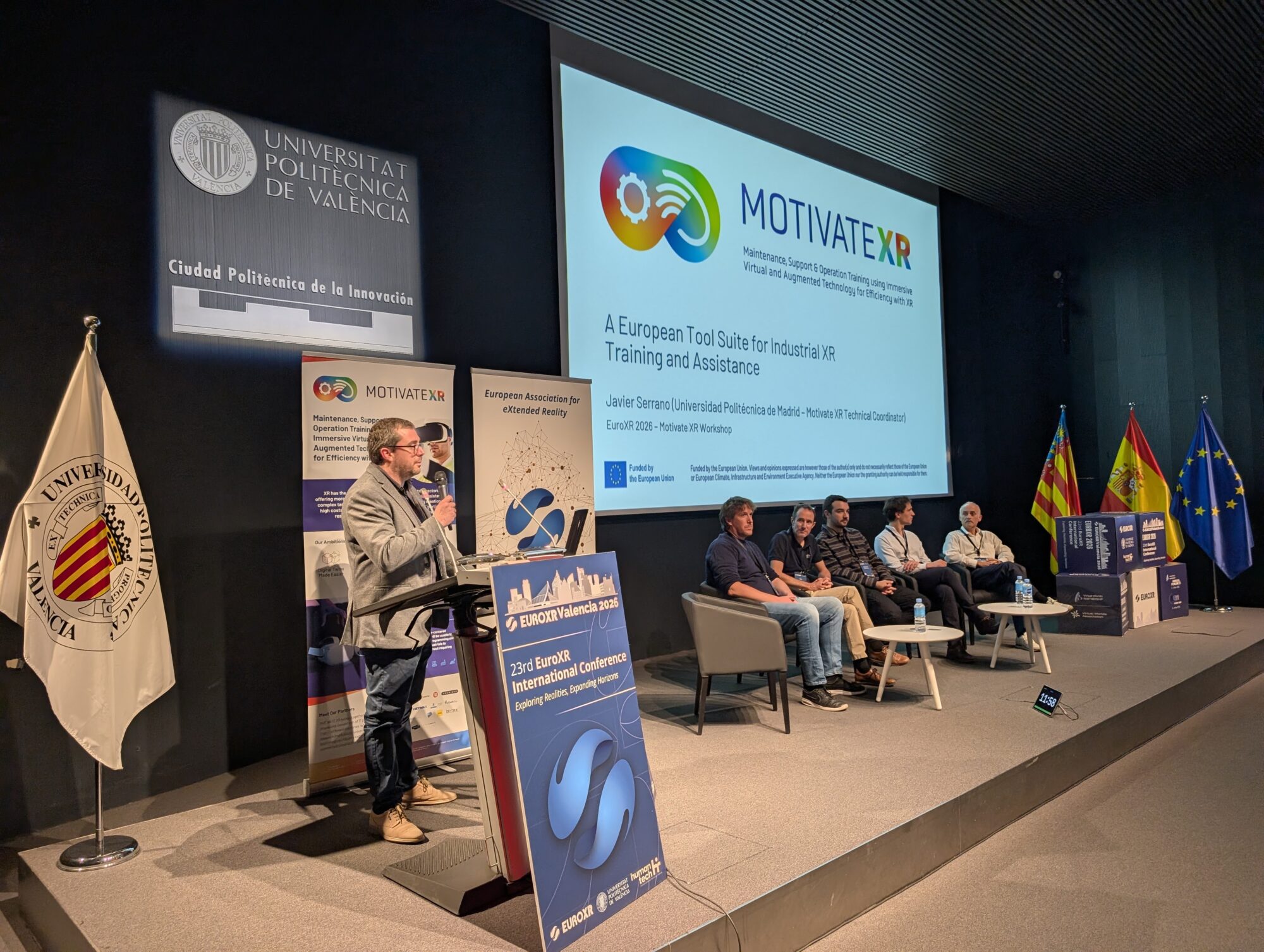
Following opening remarks from session co-chairs Alberto del Río from Universidad Politécnica de Madrid (UPM) and Iñaki Martínez from TECNALIA, the technical program kicked off with Javier Serrano, Technical Coordinator of MOTIVATE XR from the Universidad Politécnica de Madrid (UPM), presenting the project’s overall vision and technological approach.
Industrial knowledge is often distributed across technical manuals, engineering drawings, CAD models, images and operational procedures. Transforming this information into interactive XR content typically requires multiple specialised tools and substantial manual work.
MOTIVATE XR aims to simplify this process through an integrated European tool suite covering three complementary stages:
- Author: Prepare industrial assets, extract technical knowledge and create interactive procedures through AI-assisted, no-code tools.
- Share: Securely manage, publish and distribute XR content through interconnected services.
- Experience: Enable technicians, trainees and industrial operators to use immersive applications for training, procedural guidance and remote assistance.
The project’s ambitions also include simplifying digital twin creation, supporting interoperability between authoring environments and enabling collaborative industrial XR experiences.
Importantly, MOTIVATE XR follows a user-centred development approach, involving industrial users in the design and evaluation of its technologies.
The objective is straightforward: make XR content creation and use more accessible to the people who understand industrial operations best, without requiring them to become XR software developers.
KAYROX: Creating XR Experiences Directly in Industrial Environments
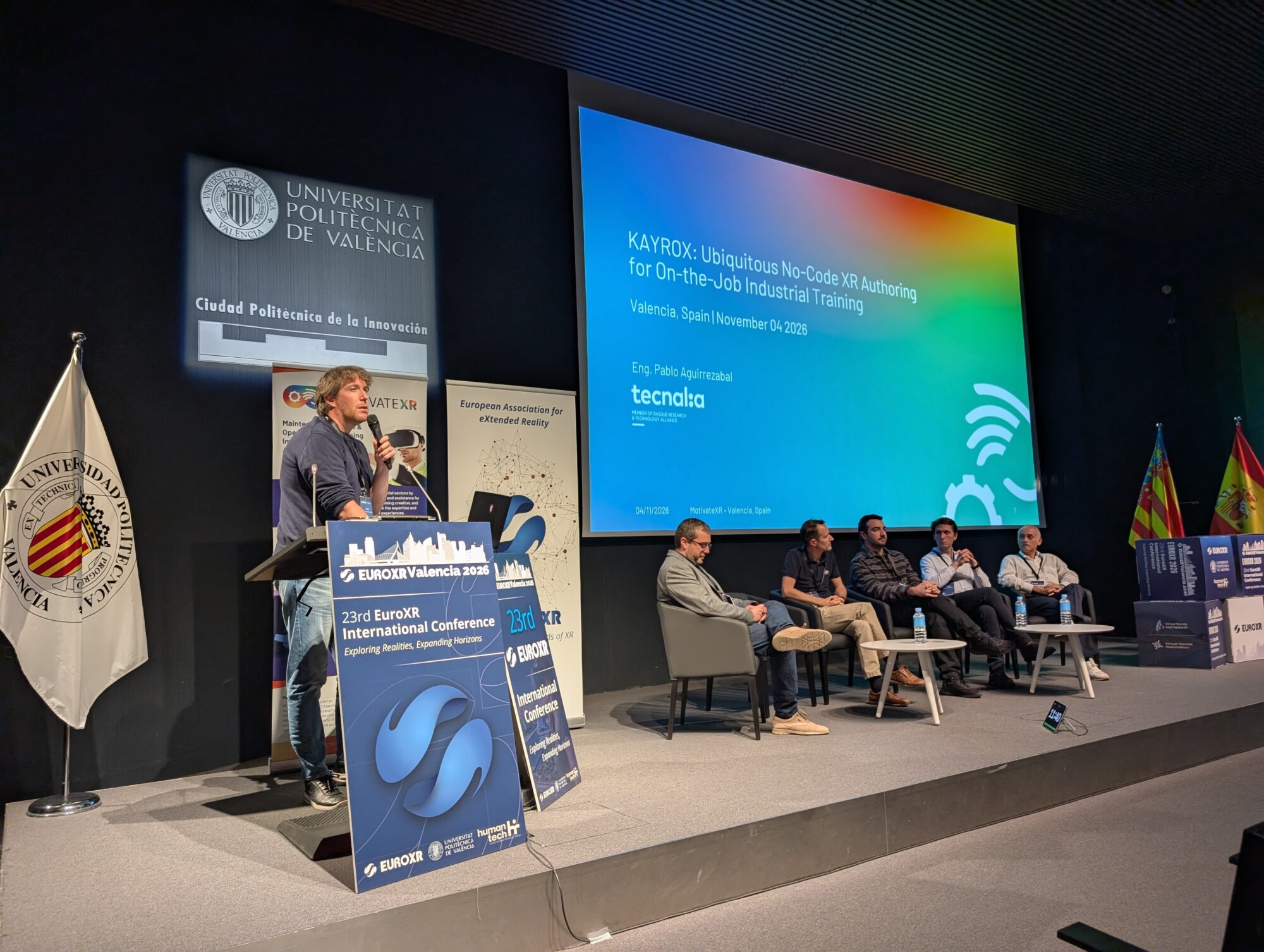
Pablo Aguirrezabal, from TECNALIA, presented KAYROX, a versatile environment for authoring and experiencing XR content.
The presentation demonstrated several capabilities developed or enhanced within MOTIVATE XR, showing how XR creation and assistance can become more flexible and accessible.
One important innovation is on-site and on-device authoring, allowing users to create XR experiences directly within operational environments using video-see-through devices, including Youbiquo’s LeonardoXR headset.
KAYROX also incorporates AI-assisted scene composition, helping users prepare immersive content with reduced manual effort. Additionally, its support for 3D Gaussian Splatting enables realistic virtual environments to be experienced through a web browser. This technology creates detailed three-dimensional representations from captured visual information.
Another significant development is the automatic alignment of virtual content with physical environments, reducing the need for repeated manual positioning of digital elements. The tool also supports integration with external services, including the MIRA Digital Twin platform, allowing industrial information to be connected with XR applications.
Beyond content creation, KAYROX provides advanced remote assistance capabilities. Experts can share 3D objects and PDF documentation during support calls, while automatic session recording facilitates subsequent review, training and documentation.
These technologies contribute to three MOTIVATE XR industrial pilots: home appliances, electricity distribution and human-robot hybrid manufacturing. Together, they illustrate how accessible authoring, immersive guidance and remote collaboration can support different industrial tasks and working conditions.
Inscape: Turning Industrial Expertise into Interactive Simulations
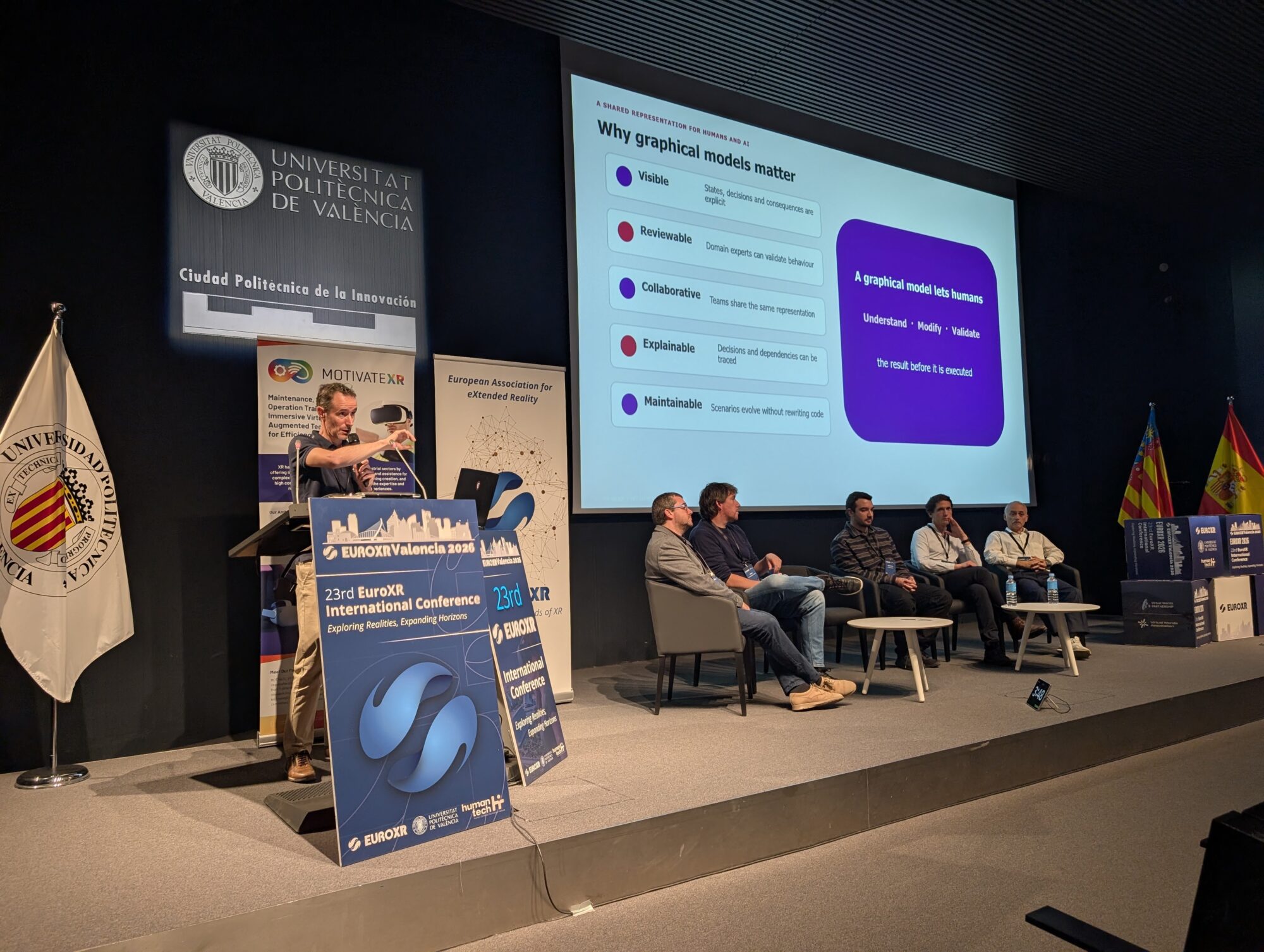
The next presentation, delivered by Eric Menou from CS GROUP, introduced Inscape VTS, a graphical authoring environment for complex XR training scenarios.
The presentation highlighted an important distinction: displaying a three-dimensional model is not the same as creating a realistic industrial simulation. A maintenance procedure may describe the correct sequence of operations, but a training simulation must often reproduce equipment behaviour, possible mistakes, operational consequences and alternative scenarios.
Inscape addresses this complexity through graphical models that allow users to define interactions, equipment states, procedures and training activities without conventional programming. This visual approach also facilitates collaboration and validation. Industrial experts can examine how a scenario works, identify incorrect assumptions and modify its behaviour before deployment.
Artificial intelligence provides additional support by helping interpret documentation and proposing scenario structures or behaviours.However, the presentation emphasised a fundamental principle: AI proposes, while the human author validates.
This combination of accessible graphical tools, AI assistance and human oversight is particularly valuable when developing training content for complex industrial systems.
Vision Module: Connecting Digital Models with Physical Objects
An XR application can display a highly accurate virtual component. But how does it determine where the corresponding real object is located?
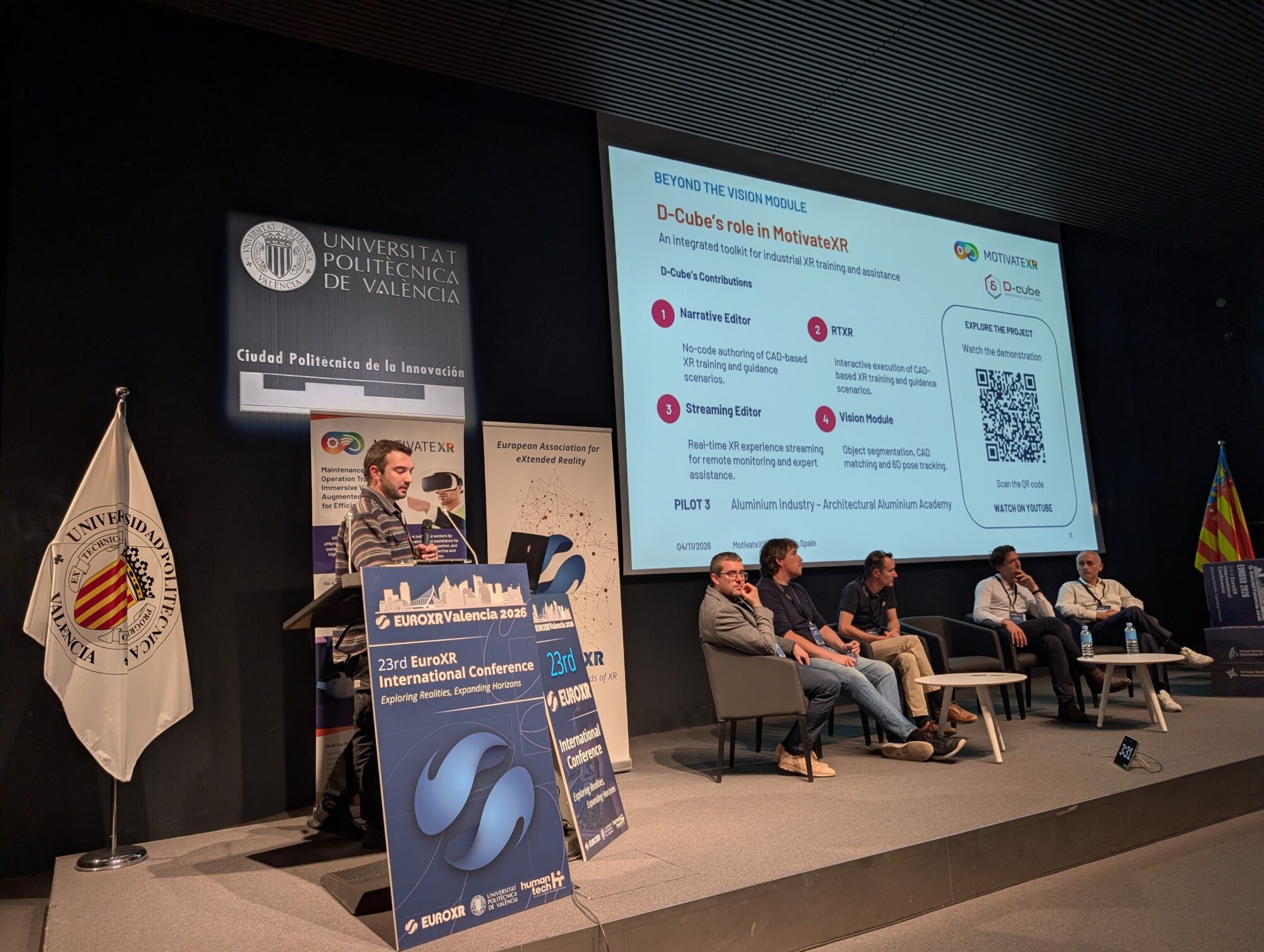
This challenge was addressed by Paschalis Choropanitis, from D-CUBE, who introduced the MOTIVATE XR Vision Module.
The system combines AI-based image segmentation, CAD model identification and three-dimensional position and orientation tracking. Its workflow begins when a user selects an object through an XR device. Artificial intelligence isolates that object from its surroundings and compares it with available digital models. The system then estimates the object’s position and orientation, allowing virtual information to be aligned with the physical component.
This process can support more accurate visual guidance, assembly instructions and inspection activities, reducing the need for repeated manual adjustments.
The presentation demonstrated a working prototype using industrial components, including aluminium profiles. It also highlighted the importance of synchronising camera images, depth information and positioning data to ensure that digital overlays correspond to the correct physical location.
Further work is focused on improving tracking robustness, particularly for objects of different sizes. These developments illustrate how computer vision can help XR systems interact more naturally with real industrial environments.
Semantic Process Engine: Transforming Manuals into Usable Knowledge
Industrial technical documentation represents an enormous source of information, but extracting relevant knowledge can be difficult. Manuals may contain thousands of pages combining procedural instructions, diagrams, components, tools and safety warnings.
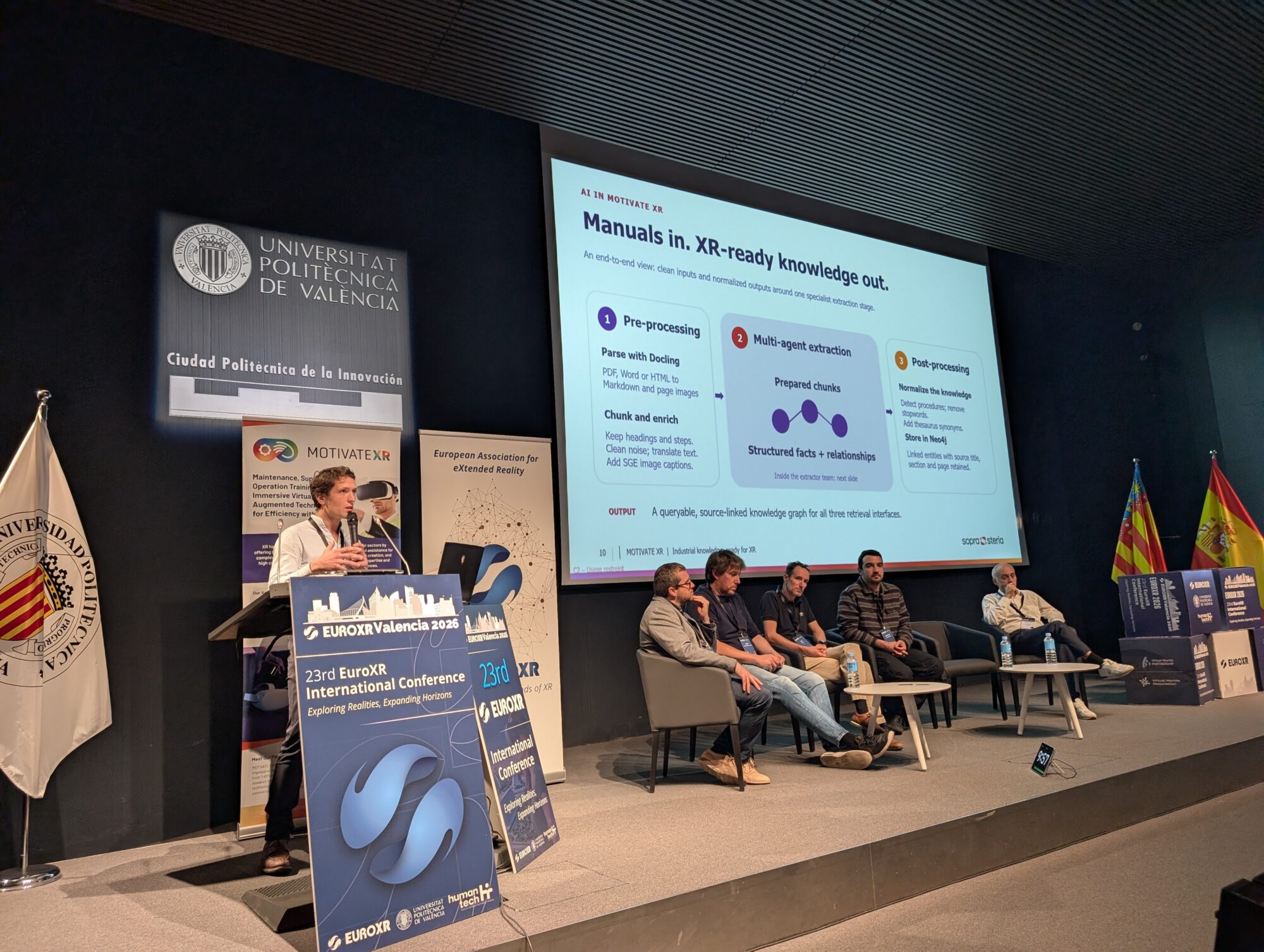
Maxime Claisse, from Sopra Steria, presented the MOTIVATE XR Semantic Process Engine, which uses AI to transform this documentation into structured, searchable knowledge.
The system processes sources such as PDF manuals, Word files and HTML documents, identifying relevant information and relationships. Specialised AI components help distinguish procedures, operational steps, equipment components, tools and safety instructions. The extracted information is organised into Knowledge Graphs, which connect related elements and preserve references to their original documentation.
For example, a maintenance procedure can be linked to its individual steps, the components involved, the tools required and associated safety warnings. This knowledge can then be accessed through software interfaces and conversational assistants.
Users can ask questions in natural language, while XR authoring environments can retrieve structured information to support the development of training scenarios.
A particularly important feature is traceability: technical information remains connected to its original sources. This is essential in industrial environments, where inaccurate or invented instructions could lead to operational or safety risks.
The Semantic Process Engine therefore aims not only to make documentation easier to search, but also to transform existing industrial knowledge into reliable information that can support XR applications.
Industrial Validation: Five Sectors, Five Real-World Scenarios
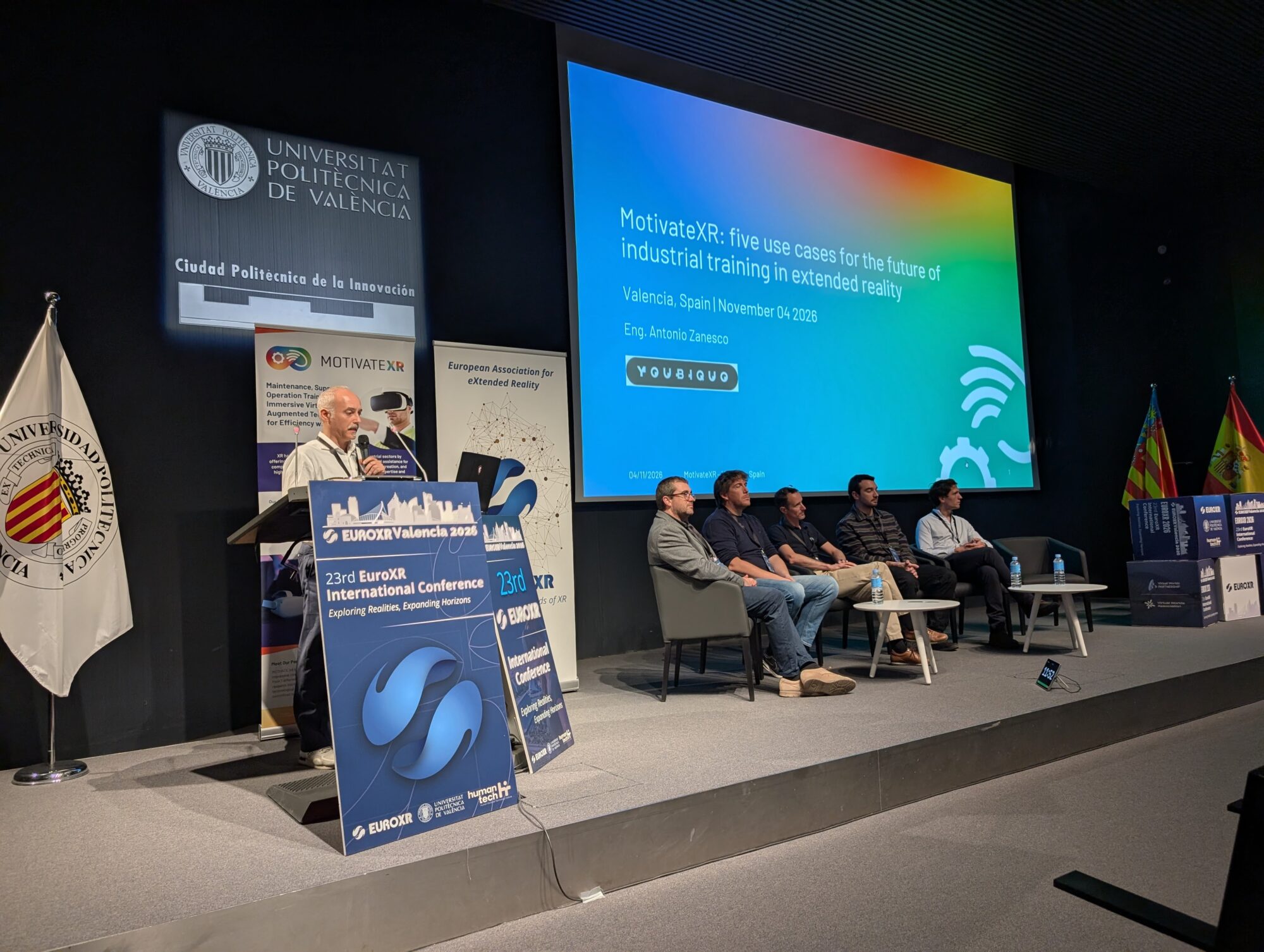
The final invited presentation was delivered by Antonio Zanesco, from Youbiquo, who introduced the five industrial pilots and the results of their initial evaluation.
MOTIVATE XR is being validated across five complementary industrial sectors:
- Aerospace: Virtual reality supports aircraft maintenance training, including inspection procedures involving an Airbus A320 heat exchanger.
- Home appliances: Augmented reality provides step-by-step repair guidance, complemented by remote expert assistance.
- Aluminium: XR glasses guide trainees through aluminium window assembly using animated three-dimensional instructions.
- Electricity distribution: Engineers practise infrastructure inspection and maintenance procedures using interactive XR content.
- Human-robot hybrid manufacturing: Workers assemble equipment alongside a collaborative robot, supported by immersive instructions.
These scenarios allow the consortium to evaluate its technologies under different operational conditions, with different equipment, user profiles and training requirements.
What Did the Initial Evaluations Reveal?
The beta evaluation, conducted during September and October 2025, provided valuable feedback on usability and user experience.
The project employed the System Usability Scale (SUS), a standard questionnaire that produces scores between 0 and 100. A value of 68 is commonly used as a reference benchmark.
Three of the five pilots reached or exceeded this benchmark:
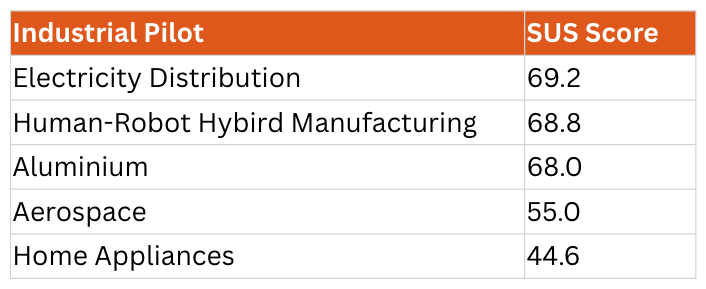
The results highlight both the progress achieved and the improvements still required.
Users appreciated the clarity of three-dimensional instructions and the engaging nature of immersive training. However, they also identified challenges related to interface usability, interaction methods, headset comfort and system stability.
The project is using this feedback to improve its technologies before the final evaluation phase.
Planned activities include testing with more than 100 trained users across the five sectors and assessing practical indicators such as time savings, operational efficiency and error reduction.
The emerging lesson is that successful XR adoption depends not only on technological capabilities, but also on intuitive, comfortable and reliable experiences for industrial users.
Beyond XR: Strengthening Europe's Immersive Technology Ecosystem
The workshop also provided an opportunity to promote the Beyond XR Cluster, a European collaboration initiative connecting projects funded through Horizon Europe and Digital Europe.
Beyond XR brings together research and innovation activities covering Extended Reality, Artificial Intelligence, robotics and immersive technologies.
At EuroXR 2026, MOTIVATE XR highlighted the importance of strengthening cooperation between European initiatives, exchanging research outcomes, promoting interoperability and accelerating the adoption of human-centred XR.
The cluster connects 20 European projects, including nine active initiatives and eleven completed projects, creating opportunities for knowledge exchange and collaboration across industrial, educational and societal applications.
This collective approach reinforces the importance of building a connected European XR ecosystem rather than developing isolated technological solutions.
Looking Ahead: Towards Practical and Accessible Industrial XR
The MOTIVATE XR workshop at EuroXR 2026 demonstrated how complementary technologies can contribute to a more accessible industrial XR ecosystem.
No-code authoring reduces barriers to content creation. Artificial intelligence helps transform technical documentation into structured knowledge. Computer vision connects digital instructions with physical equipment. Interoperable services support content distribution, while industrial pilots provide essential feedback on usability and effectiveness.
The initial evaluation results also highlight an important reality: successful technological integration must be accompanied by continuous improvements in user experience.
As MOTIVATE XR advances towards its final integrated release and validation activities, the project continues working towards an ambitious objective: enabling industrial organisations to transform existing technical knowledge into practical, immersive tools for training, maintenance and assistance.
The future of industrial XR will depend not only on what users can see through a headset, but on how easily reliable knowledge can be transformed into experiences that genuinely support their work.
Learn more about MOTIVATE XR and the EuroXR Conference.
Author

Universidad Politécnica de Madrid (UPM)
Alberto del Rio completed his PhD in Communication Technologies and Systems at the Universidad Politécnica de Madrid (UPM), building on a strong academic foundation that includes a Bachelor’s Degree in Mobile and Space Communications Engineering from the Universidad Carlos III of Madrid (UC3M) and a Master’s Degree in Signal Processing and Machine Learning for Big Data from UPM. As a researcher at UPM, he focuses on innovative projects in 5G networks and artificial intelligence, applying techniques like Reinforcement Learning to optimise network efficiency and enhance Quality of Experience (QoE) in multimedia communication systems. He has published extensively in leading journals advancing the integration of AI and telecommunications.